
Ukrainians do not surrender
Let us understand who they are and why are they so much different from the Russians

The upcoming fourth anniversary of the “Kyiv in three days” military operation makes me come back from my semi-hiatus. So hello to everyone who missed me. I will address here the claims frequently expressed by Russian propaganda, that Ukraine is an “artificial state”.
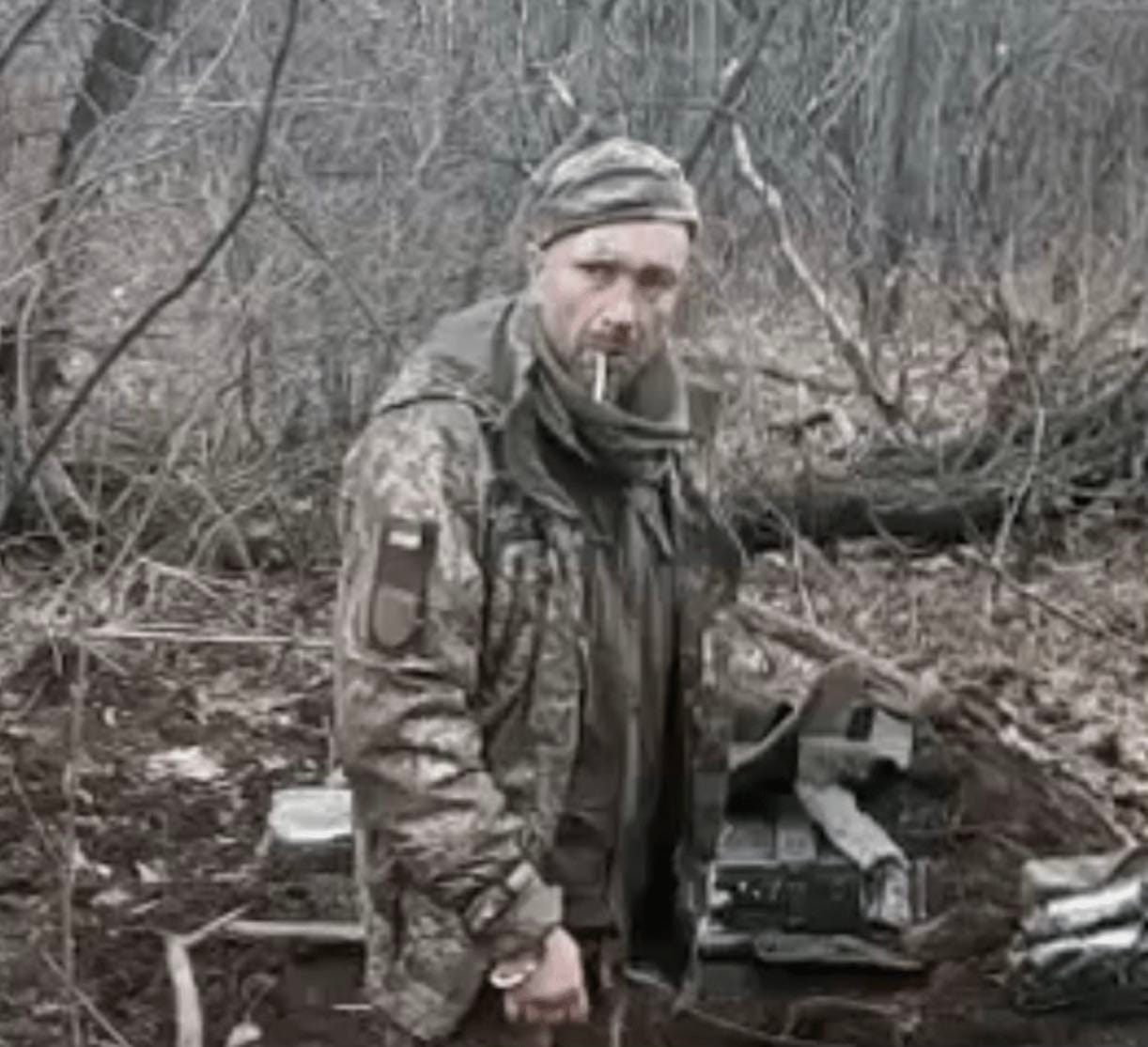
Oleksandr Ihorovych Matsievskyi was captured by Russian soldiers in December 2022. When told to surrender, he responded with “Slava Ukraini”, and then Russians killed him. They filmed their own war crime and posted it online, inadvertently creating another powerful symbol of Ukrainian identity that will be still alive in another 1000 years.
In a way, this is true - every country is a social construct. If you know a bit of history, it’s fairly easy to write an essay about how any given country is artificial. The easiest examples for me would be (in no particular order): Belgium, Norway, USA, France, Italy, and of course Russia. Your typical European country either never existed as a fully sovereign state before 1900 (Finland! Ireland! Estonia!) or it kind of did, but the continuity with the ancient forerunners is questionable and actually invented during the 19th century nation building (we are the Vikings! we are the Sarmatians! and we are the Hibernians!).
No matter how much effort you put into proving that “Croatia is artificial”, it appeared on a map because some people died for it. Ask another question instead: what is so special about Ukrainian (or Irish, or Norwegian, or Latvian, or Belgian, etc.) identity that some people at some moments of history were willing to sacrifice their lives for it?
With this question, you might reach valuable insights. Of course, many did before me - and I don’t aspire to serve you scientific discoveries. What I write here can be found in books by Tim Snyder (and in a number of books that were never translated to English).
When describing Ukrainian identity, one has to begin with stating that it is Ruthenian (Eastern Slavic). I hope everybody here already understands the difference between “Ruthenian” and “Russian”. It is the same as between “Swedes” and “Scandinavians” (as peaceful as they might seem, don’t make this mistake in a club on a Friday evening - neither in Stockholm, nor in Oslo or Copenhagen).
All Ruthenian nations consider themselves heirs of medieval Kyivan Rus. By accepting Eastern Christianity in the late 10th century, it became a part of the Byzantine sphere of influence. HOWEVER, it bordered Poland and Hungary, the eastern flank of Western Christianity. After a series of wars, so called Red Ruthenia appeared on a map: ethnically and religiously Eastern, but politically a part of the West.
Kyivan Rus collapsed in the 13th century, largely due to Mongolian invasion. Three main splinter states emerged: Vladimir-Suzdal, Novgorod, and Kingdom of Galicia-Volhinia (a sort-of continuation of the Red Ruthenia). Suzdal was also short living, eventually leading to the appearance of Principality of Moscow, a splinter of a splinter of a splinter, which - with the aid of the Mongols - managed to conquer the other splinter states and finally slaughter Novgorod.
The massacre of Novgorod was the foundation of contemporary Russia. They self declared themselves the sole successors of the Kyivan Rus (and the Byzantine Empire for good measure), but they captured the city of Kyiv only in 1657. Being a successor of Kyiv without Kyiv is kind of embarrassing, this is why they are so hellbent on taking in back. It was never just about the Donbas or the “Russian speaking population”.
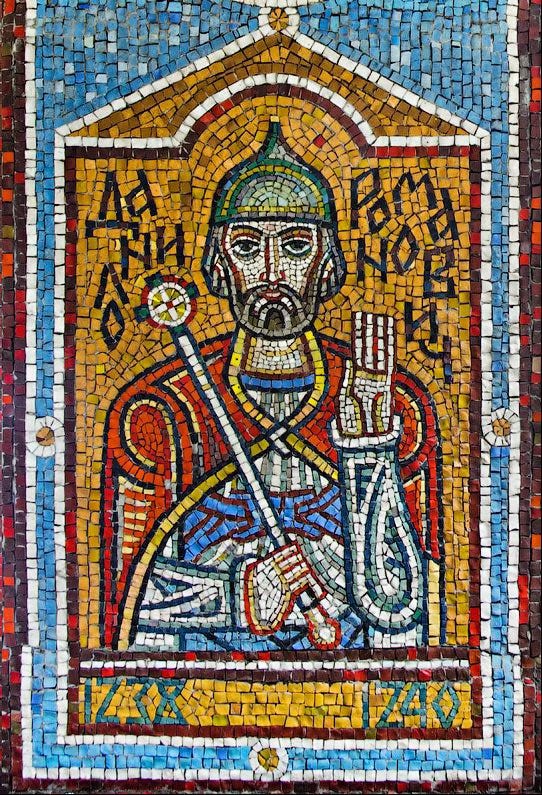
As the Cyryllic inscription is saying, this is king Danylo Romanovich on a mosaic in Kyiv metro station. You can almost hear him comforting the civilians hiding from Russian air raids “don’t panic, carry on, there were even worse moments in centuries”
Kingdom of Galicia went its own way, but it also did not survive long. It was absorbed by Poland and Lithuania, first separately, and when Poland and Lithuania united, it became a part of the Commonwealth. Unlike Red Ruthenia, which was never a sovereign entity, it was a proper kingdom, so it never completely disappeared (not even until today). Crucially: its king Danylo was crowned by the Western pope in 1253, making him the first pro-Western Ruthenian ruler.
There’s a quote attributed to him, probably apocryphal, but very important for the nation building. Allegedly, when given the crown, he said he would rather prefer an army. All the educated persons in Ukraine know this quote, so it is likely Zelensky was paying homage to king Danylo with his “I don’t need a ride, I need ammunition”.
The failure of Commonwealth to transform itself into triple kingdom (Poland-Lithuania-Ukraine) is commonly considered to be the main cause of its collapse in the late 17th century. Before it happened, it led to the creation of the Ukrainian Greek Catholic church in 1595 (loyal to the pope, but maintaining Eastern rites) and the emergence of the concept of Ukraine. The famous “Radziwiłł map” from 1613 for the first time mentions Ukraine in the contemporary sense.
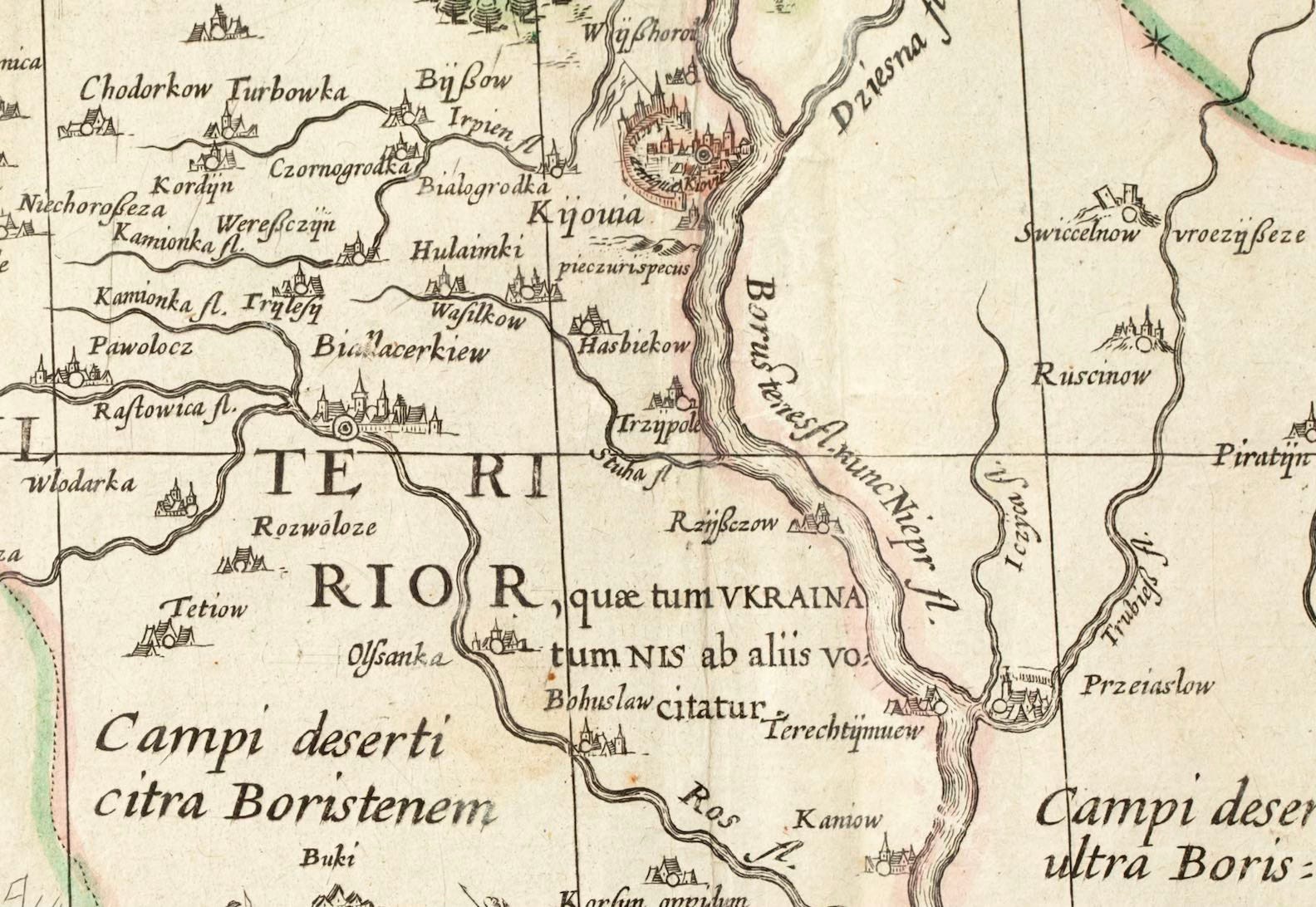
Zoomed part of the Radziwiłł Map - near Kyiv you can find Latin remark “[this area] we also call Ukraina”, via Wikipedia
This map is also the first one to mention Cossacks, semi-nomadic people inhabiting the wastelands created by the Mongolian invasion. The collapse of post-Mongolian empire created a vacuum of wastelands (“Campi deserti” on the Radziwiłł map) populated by outlaws of various origins, united mostly by their will of having no masters. The failure of the Polish-Lithuanian Commonwealth to integrate them was another reason for its downfall - however, for a very interesting while, the so-called “Kozacy rejestrowi” (literally, “licensed outlaws”), were the bulwark of the Eastern Flank of Western Civilization. Until we told them to bugger off, precipitating a cataclysm.
These two elements merged in the 17th century, creating the Ukrainian identity. Ruthenian, but Western. With Orthodox liturgy, but loyal to the pope in Rome. And with Cossack mentality. Remember “Russian warship, go fuck yourself”? That’s as Cossack as it gets.
Ukrainian identity is not Polish, not Russian, not Hungarian, not Lithuanian, not Turkish and of course not Mongolian (although in the last millennium, Ukraine was ruled entirely or partially by these countries, with a sprinkle of Italian merchant republics for spicing). It emerged as a result of complex mixture of events: rise and fall of Kyivan Rus, then of the Golden Horde, then of the Commonwealth of Poland and Lithuania, then of the Ottoman Empire. It’s not that unusual in Europe: if you ask “why Belgium is a thing?”, the answer will be a similar chain of events.
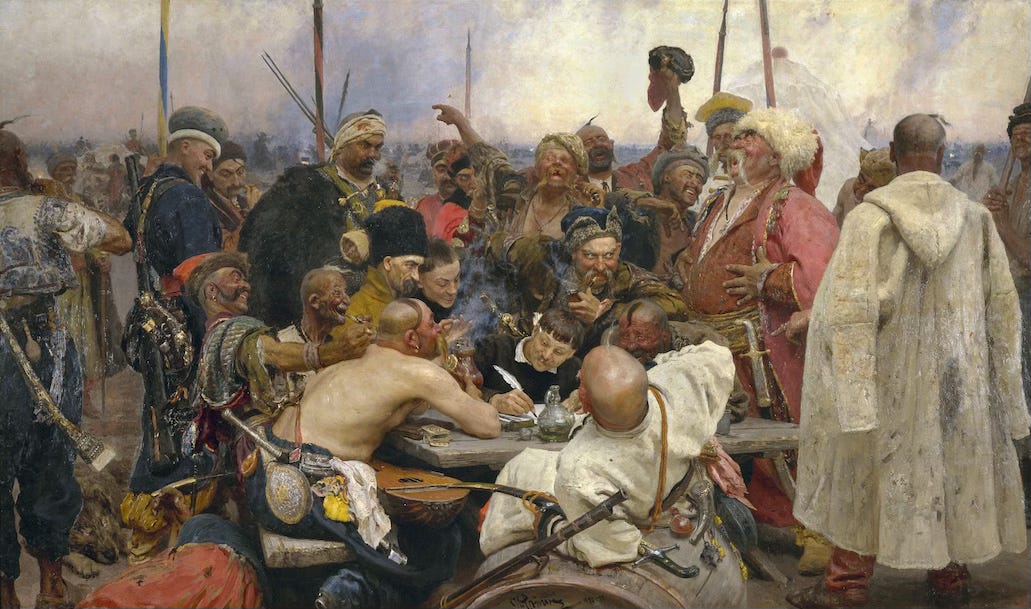
“Reply of the Zaporozhian Cossacks”, a famous painting by Ilya Repin from 1890. It depits Cossacks enjoying their de facto independence writing super-insulting reply to their de iure sovereign. It probably never happened, but this is yet another example of the Cossack mythos in Eastern European culture. BTW: like many leading Russian scholars and artists, Repin was of Ukrainian origins.
It’s true that they never had their own independent state before 1917, but Ireland emerged on a map roughly in the same period, and nobody calls it “artificial”. Also, the Cossacks were never independent de iure, but for more than a century they were independent de facto.
For 4 centuries Ukraine has fought many wars for independence. They were mostly lost. The current one is the among the most successful (if not THE most successful!) in their history. It goes definitely way better than their first republic (1917-1922).
I noticed that I used the expression “short lived” more than once in this note, which sums up the tragedy of Ukraine. And if you consider all this, you can understand why they are reluctant to give up their independence. This is their informal national motto: “Ukraine - proudly refusing to surrender for centuries”.
It's great to see you back, Eastsplaining!
A great, illuminating read, so well written.